Editorial note: the article published here is an edited version of that published in the Athenæum Library e-Bulletin, 44 (Easter 2026).
When I say I’m a librarian, I can tell that many think I spend most of my working hours just putting books on shelves. Although this underestimation irks me a little, I don’t concede as much as I might that I do spend a not-insignificant amount of time doing something along the lines of just that. However, I want to defend the intellectual value and political implications of arranging books. More than just helping readers to find the books they want and to explore literature on a particular subject, a library’s system for shelving represents its users’ collective worldview. We reveal much about our priorities, values and influences through the way we categorise complex information.
Classification, in the library context, is the process of distilling a piece of work down to its aboutness, then taking this multidimensional aboutness and flattening it down into an alphanumeric code that can be filed in a linear sequence. Broad disciplines branch out into smaller subjects, and concepts at each level of the hierarchy follow on logically from one another. A novice taxonomist often starts with the worthy goals of empiricism and objectivity, but it is not long before he is faced with a dilemma that forces him to pick a side on a controversial matter.
My former employer, Chatham House, for example, ‘does not take institutional positions on policy issues’;[1] nevertheless, its library, through its classification, implicitly adopts a stand on as thorny an issue as Taiwan’s statehood. Classmarks add letters to subdivide subjects, so if U is the classmark for Asia, UC for China and UCH for Hong Kong, where is Taiwan to go? It could, like Hong Kong, have a notation subsidiary to China’s starting with UC, sticking to the mainland Chinese view that the island is an administratively independent but integral part of China. The library, though, puts Taiwan at UB therefore tacitly acknowledging the Republic of China as an equal to the People’s Republic. This may have not gone unnoticed by some Chinese visitors.
All library classifications present a version of geopolitical reality when dividing subjects by place, but libraries, not famous for their agility, struggle to keep their categorisations in pace with shifting borders and groupings. Every update to classification systems entails the retrieving, relabelling, recataloguing and reshelving of books; for many librarians, the effort is just not worth it. That is why most library classifications in use today, conceived in the 20th century, still rely on Cold War-era divisions between countries. The Baltic states usually sit awkwardly under a ‘USSR’ class, which may have been renamed something like ‘Russia and the former Soviet Union’, but any real change in structure to mirror the new international order and the place of the European Union is rare.[2]
Classification at the Athenæum
In the Athenæum’s library, geopolitical influence can be seen in the choice of classification scheme over time. The Club began with a homegrown shelving system: Spencer Hall, appointed librarian in 1833, published a pamphlet outlining a plan for the classification of the Club’s books in 1838, in which he decides against following any other established system to the letter. He used Thomas Hartwell Horne’s classification as a basis for his own and sought Members’ input to tailor it to current consensus. Hall was aware of the short shelf-life of any consensus, writing in his introduction: ‘systems which rest, not upon positive or determined facts, but which essentially depend upon opinion for support, must, of necessity, be affected by its current: every one naturally considers his own theory to be best; and the latest is in general reckoned as superior to that by which it has been preceded’.[3] A glimpse of the early Victorian worldview in Hall’s pamphlet is its classification of languages, which are subdivided geographically, not linguistically. Finnish and Basque are found under a European heading, while ‘Hindu’ languages, such as Sanskrit and ‘Pushtoo’, are consigned to an Asiatic category, even though the common origins of Indo-European languages had already been proposed in 1786 by William Jones.[4] Through this, the shelves reflect a particular period’s view of the international order rather than any timeless structure of knowledge.
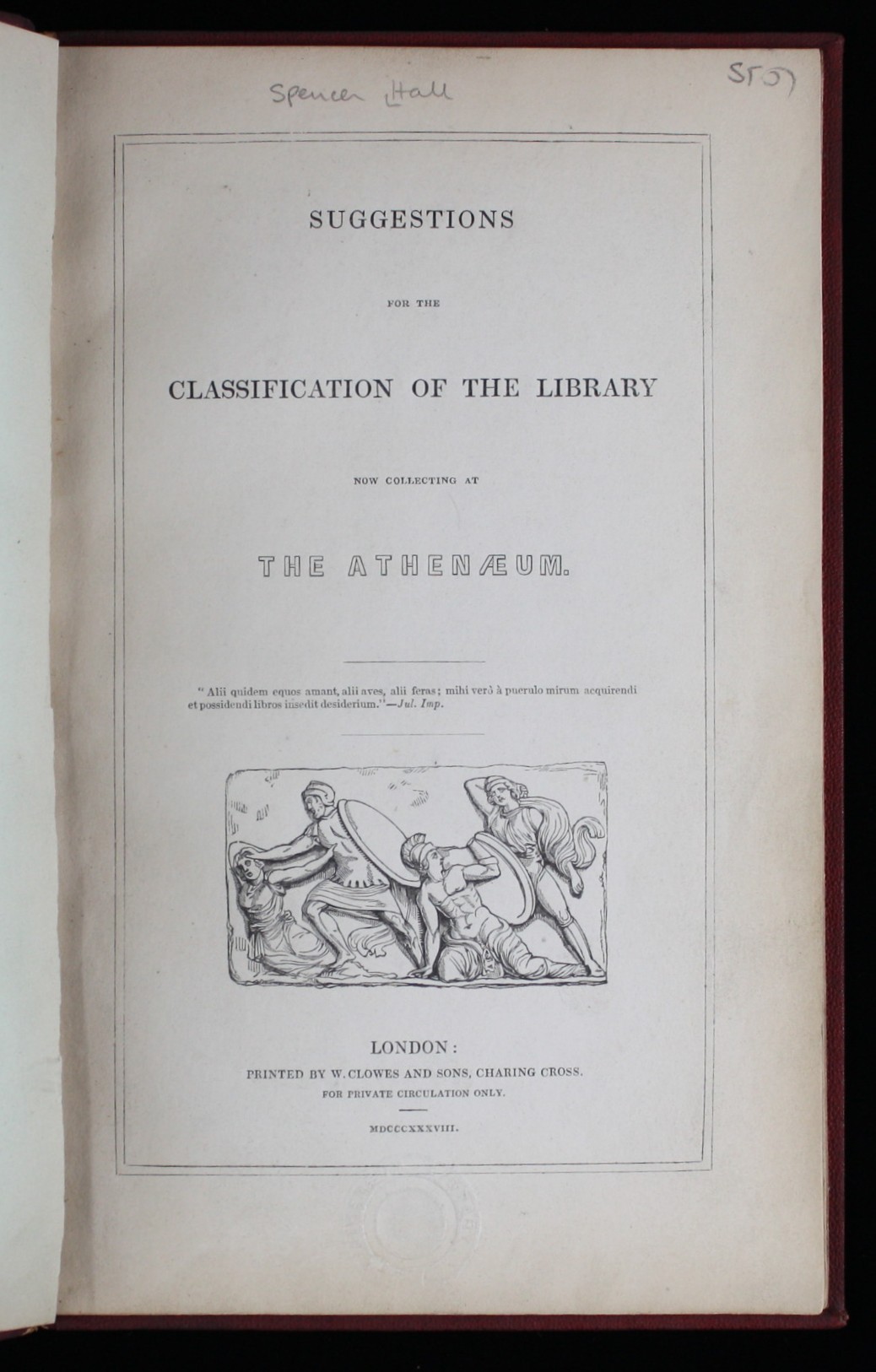
Hall’s system could not be maintained indefinitely: as shelving space ran out, librarians struggled to maintain a semblance of subject sections; a book had to go simply wherever there was space for it. It did not help that books used to be given fixed shelf references rather than classmarks, which were recorded by hand in the catalogue volumes, making it more cumbersome to reorganise the collection. Inevitably, the library became very disordered: to relieve shelving pressure, books were sold or disposed, and surviving volumes were shifted along and consolidated, but this movement decoupled the books’ catalogued shelf references from their new home. ‘As a result of this situation many parts of the Library are in a state of near chaos’, wrote the chairman of the Library Committee in a memorandum in circulated in 1963. ‘The existing Catalogue is no longer an adequate guide to the contents of the Library’, and ‘many members find it difficult to trace books in the Catalogue and have given up any attempt to do so’, he continued.[5] At their meeting on the 7 November 1963, the committee decided that work was to begin on the recataloguing and reclassification of the entire collection, a project which was only announced as completed at the annual general meeting in 1975. The chosen system was that of the Library of Congress.[6]
One reason the committee opted for the Library of Congress Classification (LCC) was the availability of published volumes enumerating the scheme’s classes and with an alphabetical index of the subjects, which were to serve as a premade extra search tool alongside the card catalogues.[7] LCC’s enumerative nature (all possible combination of subjects are predetermined and listed, rather than allowing the classifier to synthesise classes from various facets) imposes strict limitations. A system designed for one specific collection in a governmental library, it is naturally more granular when listing classes in history, politics, law and economics than sciences, mathematics, arts and literature. Indeed, it was never intended for use by any other library when it was published in 1901 and it has never pretended to be a universal classification of human knowledge. Librarian of Congress Herbert Putnam stated this plainly in the 1916 annual report: ‘the scheme adopted has been devised with reference (1) to the character and probable development of our own collections, (2) to its operation by our own staff, (3) to the characters and habits of our owns readers, and (4) to the usages in vogue here’.[8] Such a pragmatic system is, however, markedly different to its intellectual origins.
The 1901 schema standardised the classification system that had been evolving since Thomas Jefferson sold his collection to the Library to replace what was lost in the 1814 burning of Washington. Jefferson’s books were organised based on the system used in Denis Diderot and Jean le Rond d’Alembert’s Encyclopédie, which itself was modelled on Francis Bacon’s categorisation of knowledge as set out in his Advancement of Learning, 1605.[9] Bacon distinguished human knowledge (derived from the senses) from theology (derived from revelation). Human knowledge was subdivided into history (knowledge from memory), poesy (knowledge from imagination) and philosophy (knowledge from reason).[10] Though his is the origin of the system, Bacon’s top-down approach of increasing subdivisions of the universe of knowledge contrasts with the modern LCC’s bottom-up approach, which starts with the books themselves and clusters them into classes.
What, then, does the choice of LCC say about the Club and world order? Pessimistically, one could see a representation of modern Britain in the reliance on an American governmental institution to impose order on post-war disarray. LCC together with the even more widely used American Dewey Decimal System dominate the English-speaking library landscape, with the Library of Congress as the source of policies and standards like the legislature of an American library empire, and with Britain is its colony. This new imperialism was clear when in 2017, Republican congressmen added a provision to a bill that would forbid the Library of Congress from changing the indexing term ‘illegal aliens’ to ‘noncitizens’: American lawmakers were dictating the language of British bibliographic description.[11] On the other hand, a rosier take is that the Athenæum Library still embodies a degree of English, Baconian epistemology in its division of subjects amongst its libraries: history in the South Library, poesy in the North Library and philosophy in the West Library.
While I am not proposing another 12-year reclassification project, I do wonder what an originally Athenian classification would say about the world if we were starting from scratch today, and whether we would have any more capacity than Hall to make it future-proof. Would we take on science, literature and arts as our top-level categories to mirror John Wilson’s Croker’s chief cohorts of Athenians, or adopt a more modern approach? Either way, future librarians would see in any new arrangement a snapshot of thought in our own moment.
‘Our Editorial Standards’, Chatham House, n.d. https://www.chathamhouse.org/about-us/our-editorial-standards [accessed 2 March 2026]. ↩︎
Library of Congress, ‘History of Russia. Soviet Union. Former Soviet Republics’, webpage, Library of Congress. Linked Data Service, n.d. https://id.loc.gov/authorities/classification/DK1-DK949.5.html [accessed 26 February 2026]; J. Mills and Vanda Broughton, ‘Bliss Bibliographic Classification. Introduction and Auxiliary Schedules. Auxiliary Schedule 2: Place’, London: Bowker-Saur, 1977 https://www.blissclassification.org.uk/Class1/PlaceSchedule.pdf [accessed 26 February 2026]. ↩︎
Spencer Hall, Suggestions for the Classification of the Library Now Collecting at the Athenæum (London: W. Clowes and Sons, 1838), p. [1]. ↩︎
Jay H. Jasanoff, Indo-European Languages - Establishment, Spread, Diversity, 14 January 2026 https://www.britannica.com/topic/Indo-European-languages/Establishment-of-the-family [accessed 3 March 2026]. ↩︎
‘Re-Cataloguing and Classification of the Athenaeum Library. Memorandum by the Chairman of the Library Committee’, 21 November 1963, Athenæum Archive, LIB 8/9. ↩︎
‘The Athenaeum. Library Committee. Minutes of the Special Meeting Held on Thursday 7th November, 1963’, 7 November 1963, Athenæum Archive, COM 7/11. ↩︎
‘Re-Cataloguing and Classification of the Athenaeum Library’. ↩︎
Henry Putnam, ‘Report of the Librarian’, in Report of the Librarian of Congress and Report of the Superintendent of the Library Building and Grounds for the Fiscal Year Ending June 30 1916 (Washington, D.C.: Government Printing Office, 1916), p. 103. ↩︎
Lois Mai Chan, Immroth’s Guide to the Library of Congress Classification (Littleton, Colorado: Libraries Unlimited, 1980), p. 16. ↩︎
Francis Bacon, The Advancement of Learning, ed. by Henry Morley (London: Cassell & Company, 1893) https://www.gutenberg.org/cache/epub/5500/pg5500-images.html [accessed 26 February 2026]. ↩︎
Jasmine Aguilera, ‘Another Word for “Illegal Alien” at the Library of Congress: Contentious’, U.S., The New York Times, 22 July 2016 https://www.nytimes.com/2016/07/23/us/another-word-for-illegal-alien-at-the-library-of-congress-contentious.html [accessed 27 February 2026]. ↩︎